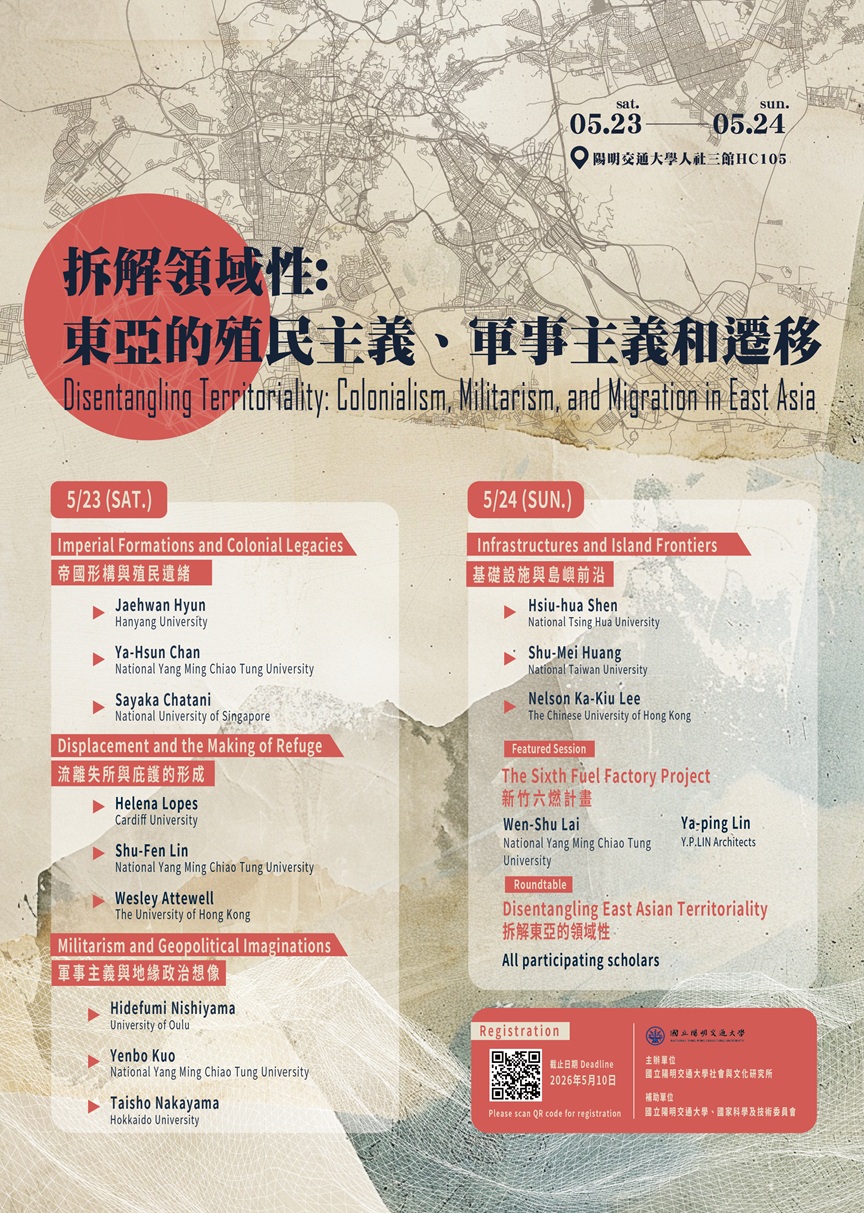
【拆解領域性:東亞的殖民主義、軍事主義和遷移】115/5/23-24國際研討會報名開始!
【拆解領域性:東亞的殖民主義、軍事主義和遷移】國際研討會
Disentangling Territoriality: Colonialism, Militarism, and Migration in East Asia
會議日期:2026年5月23-24日
會議地點:陽明交大光復校區人社三館
周邊活動、更多資訊及報名表單:
https://sites.google.com/nycu.
本次國際會議以殖民主義、軍事主義與遷移為主要分析視角,
在這些歷史過程背後,可以看到三股彼此牽動的力量。
會議亦特別關注各類型的「危機時刻」——無論是生態、
本次會議匯集歷史學、地理學、人類學、
This international conference explores the shifting dynamics of territoriality in East Asia through the lenses of colonialism, militarism, and migration. Rather than treating “East Asia” as a bounded geographic unit, it approaches the region as a space simultaneously shaped by and exceeding the colonial and postcolonial cartographies instituted by empires, nation-states, regional security alliances, and capitalist frontierization. From imperial expansion and wartime occupation to Cold War divisions and post–Cold War realignments, territorial regimes in East Asia have been continually constituted and reconfigured through diverse infrastructures—legal, economic, military, and logistical—as well as through various modes of knowledge production.
Three interconnected forces have been central to these processes. Colonialism has instituted overlapping orders of things—racial, spatial, and juridical—alongside extractive economies. Militarism and militarization—through bases, fortifications, security regimes, and practices of extra-territoriality—have entrenched forms of spatial control and ideological normalization. Migration, both forced and spontaneous, human and non-human, has persistently unsettled, negotiated, and redefined borders, belonging, and territorial logics. This conference examines how these forces, operating together and in tension, have configured both the material and imaginary geographies of the region.
Particular attention is given to moments of crisis—ecological, political, or economic—that disrupt and recalibrate these spatial orders, generating new claims to sovereignty, legitimacy, and mobility. It is often at such moments of rupture that the entanglements of colonialism, militarism, and migration become most visible, giving rise to contested geographies and evolving territorial practices.
Bringing together scholars from history, geography, anthropology, political theory, and related fields, the conference invites critical engagement with the spatial politics of East Asia and the enduring—and still unfolding—legacies of empire, violence, and mobility.